Fat freezing, lipolysis injections and radiofrequency: how body contouring options compare
By Ingrid Tan, Senior Editor · Updated 2026-09-15

This is general information, not medical advice. Ask a qualified practitioner about your own situation.
Non-surgical body contouring covers several different technologies that get lumped together under one label. They work in different ways, feel different and suit different questions. This guide compares the three you will meet most often. It does not rank them, because which is appropriate depends on an assessment of you.
The three approaches in brief
| Method | How it works | Typical questions to ask |
|---|---|---|
| Cryolipolysis (fat freezing) | Controlled cooling is applied to a targeted area | How many cycles, how long between sessions, what sensations to expect |
| Lipolysis injections | A solution is injected into a small area | Who is qualified to inject, what is in the solution, what swelling to expect |
| Radiofrequency | Heat from radiofrequency energy is delivered to the skin and tissue | How many sessions, what skin sensations are normal, who it is not suitable for |
Each of these has a short definition in our glossary: cryolipolysis, lipolysis injections and radiofrequency skin tightening. This guide is about choosing between them.
Different tools, different jobs
Cooling and injection methods are aimed at a small, defined area. Radiofrequency is more often discussed in relation to skin tightness than to a specific pocket of tissue. A clinic that offers only one method may lean toward it, so ask why they recommend what they do and what the alternatives would be.
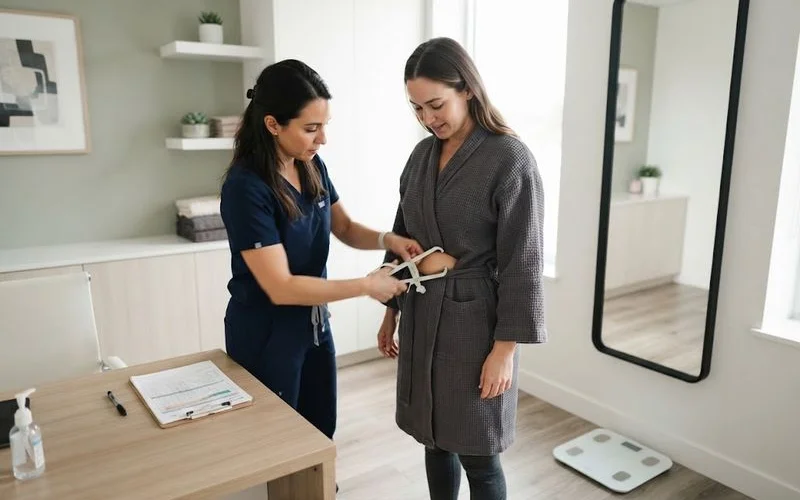
What to ask at the consultation
- What is the method designed to do, and what is it not designed to do?
- How many sessions do you recommend, and what is the total cost?
- What are the common side effects, and the rare serious ones?
- Who carries out the treatment, and what is their training?
- Do you take before photos, and how do you review progress?
- What happens if I am unhappy?
If a clinic cannot answer these plainly, that tells you something. Reviewers on this site who write positively about body contouring clinics tend to describe staff who explain treatments clearly and listen. That is their experience, and it is a reasonable standard to look for.
Realistic expectations
None of these methods replaces diet, exercise or medical weight management, and none can be promised to work for you. Be wary of before-and-after claims you cannot verify, and of any clinic that presents a single session as a fix. If a weight concern is your main goal, our guide to questions to ask about weight loss injections may be more relevant.
Why before-and-after photos need care
Photos are the main marketing tool for body contouring, and they are easy to misread. Lighting, posture, time of day, clothing and even how much someone has eaten can change how a body looks in a picture. Ask whether images are of the clinic’s own clients, whether they have consent, and whether the conditions were the same in both shots. If the answer is vague, treat the images as decoration, not evidence.
It is also worth asking how the clinic measures progress. Some use circumference measurements, some use photos taken in a fixed position, and some use neither. A clinic that tracks something concrete is easier to hold to account than one that relies on how you feel.
Lastly, think about maintenance. These treatments target areas, not your overall health or weight, so day-to-day habits still matter. A practitioner who is honest about that is more useful than one who suggests a treatment replaces it.
Choosing a clinic
Ask to see how the clinic assesses suitability, and read recent reviews for patterns in how staff communicate and handle problems. The body contouring category lists clinics offering these treatments. For how listings are scored, see our ranking method, and the home page has the full directory.
FAQ
- Is body contouring a weight-loss treatment?
- No. These treatments target specific areas and are not a substitute for weight management. A practitioner should explain what the method is designed to do.
- How many sessions are usually needed?
- It varies by method, area and clinic. Ask for the recommended number of sessions and the gap between them before you pay.
- Are results guaranteed?
- No. Responses differ between people, and a reputable clinic will not promise a specific outcome.
- Who should I ask about suitability?
- A qualified practitioner who takes a medical history. Tell them about any health conditions and medication.