Laser hair removal: what to expect from first patch test to final session
By Ingrid Tan, Senior Editor · Updated 2026-10-03

This is general information, not medical advice. A practitioner should assess your skin and health before treatment.
Laser hair removal is one of the most searched aesthetic treatments in the UK, and the process is more involved than a single appointment. Knowing the sequence helps you spot a careful clinic from a rushed one.
The usual sequence
| Stage | What typically happens |
|---|---|
| Consultation | Questions about your skin, hair, health, medication and sun exposure |
| Patch test | A small area is treated and watched for a reaction |
| Preparation | Shaving, avoiding tanning and waxing, stopping certain skincare as advised |
| Treatment sessions | A series, spaced several weeks apart |
| Aftercare | Sun protection, avoiding heat and irritating products for a period |
| Review | The clinic checks progress and decides whether to continue |
Before the first session
Expect to be asked about medication, including anything that makes skin sensitive to light, recent sun or tanning, and your skin history. Your skin tone and hair colour affect which device and settings are suitable. The Fitzpatrick scale is often used to describe skin type, and a good practitioner will explain why they chose their settings. If you have darker skin, our guide to laser and light treatments for darker skin tones goes into more detail.
Do not skip the patch test. It is the clinic’s chance to see how your skin responds before treating a larger area.
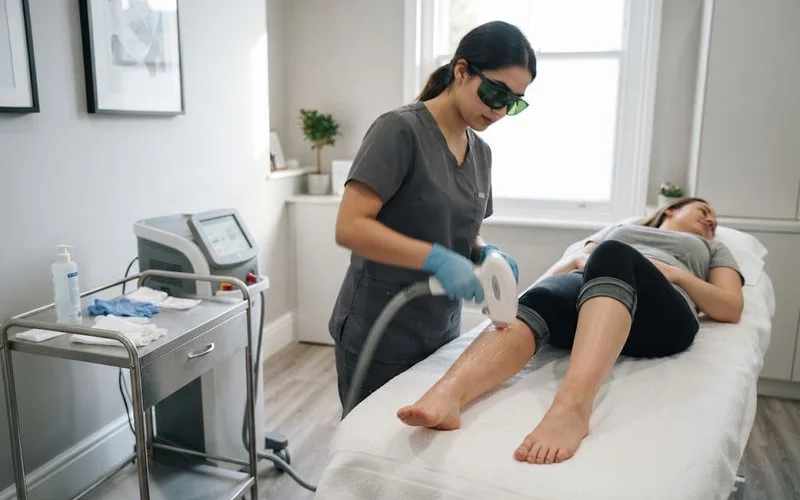
During a session
Both you and the practitioner wear eye protection. The handpiece is applied in pulses across the area. A small leg or underarm session can be quick, while larger areas take longer. Some devices cool the skin while they work. You should be told how to say stop.
Why it takes several sessions
Hair grows in cycles, and only hair in the right stage responds at a given time. That is why treatments are spaced out over weeks, with repeat visits. Any clinic that promises permanent removal in one visit is overstating what the treatment can do.
Aftercare
You may see redness or swelling for a short time. Typical advice is to avoid sun exposure and tanning, hot baths and saunas, and perfumed or exfoliating products for a few days or as instructed. If you have blistering, severe pain or anything unexpected, contact the clinic promptly.
Preparing your skin and your schedule
A few simple habits make a course go more smoothly. Avoid sunbeds and strong sun on the area for the period the clinic advises, because tanned skin changes how the laser interacts with it. Tell the clinic if you are using skincare that makes skin more sensitive. Shave rather than wax or pluck if that is what the clinic asks for, because the laser needs the hair root in place.
Think about your calendar as well. Sessions are spread over many weeks, and a holiday in the middle of the course can mean sun exposure that delays a session. Book with the diary in mind, and tell the clinic about planned travel.
Keep a note of what you were told at each visit: the settings the clinic mentions, how your skin reacted and any change in how the hair is growing back. It helps the practitioner adjust and helps you spot a pattern if something seems wrong.
Questions to ask
- What device do you use, and is it suitable for my skin tone?
- Who carries out the treatment and what is their training?
- How many sessions do you expect, and what is the total cost?
- What happens if I have a reaction?
Reviewers describe valuing clinics that explain each step and make nervous clients feel at ease. Those are individual experiences. To compare clinics, see the laser hair removal category. Our ranking method explains how listings are scored, and the home page lists everything else.
FAQ
- Do I need a patch test first?
- A responsible clinic will do one, usually at least a day or more before the first full treatment, to see how your skin reacts.
- How many sessions will I need?
- It varies with the area, hair and skin type and the device. The clinic should give you an estimate and explain that responses differ between people.
- Can I shave before treatment?
- Clinics commonly ask you to shave the area beforehand and avoid waxing or plucking. Follow the instructions you are given.
- Is it painful?
- People describe it differently. Many describe a snapping or warm sensation. Ask what comfort measures the clinic uses.